The clinic said my 38-year-old eggs were the problem — and raised donor eggs at the second visit. Then an embryologist explained the 90 days no one had told me about — and my next retrieval looked like a different woman's.
A fertility embryologist explains why your next cycle may already be decided — in the 90 days before the retrieval, not on retrieval day. And why that window is open right now.
- Why "poor egg quality" is rarely the whole story — and the 90-day window almost no clinic explains
- Why the CoQ10 you may already be taking is doing so little — and it isn't the dose
- The single daily step most women skip before a $20,000 cycle
How she did it — without another 20-pill stack, without gagging down horse-pill CoQ10, and without waiting for a science her doctors kept promising.

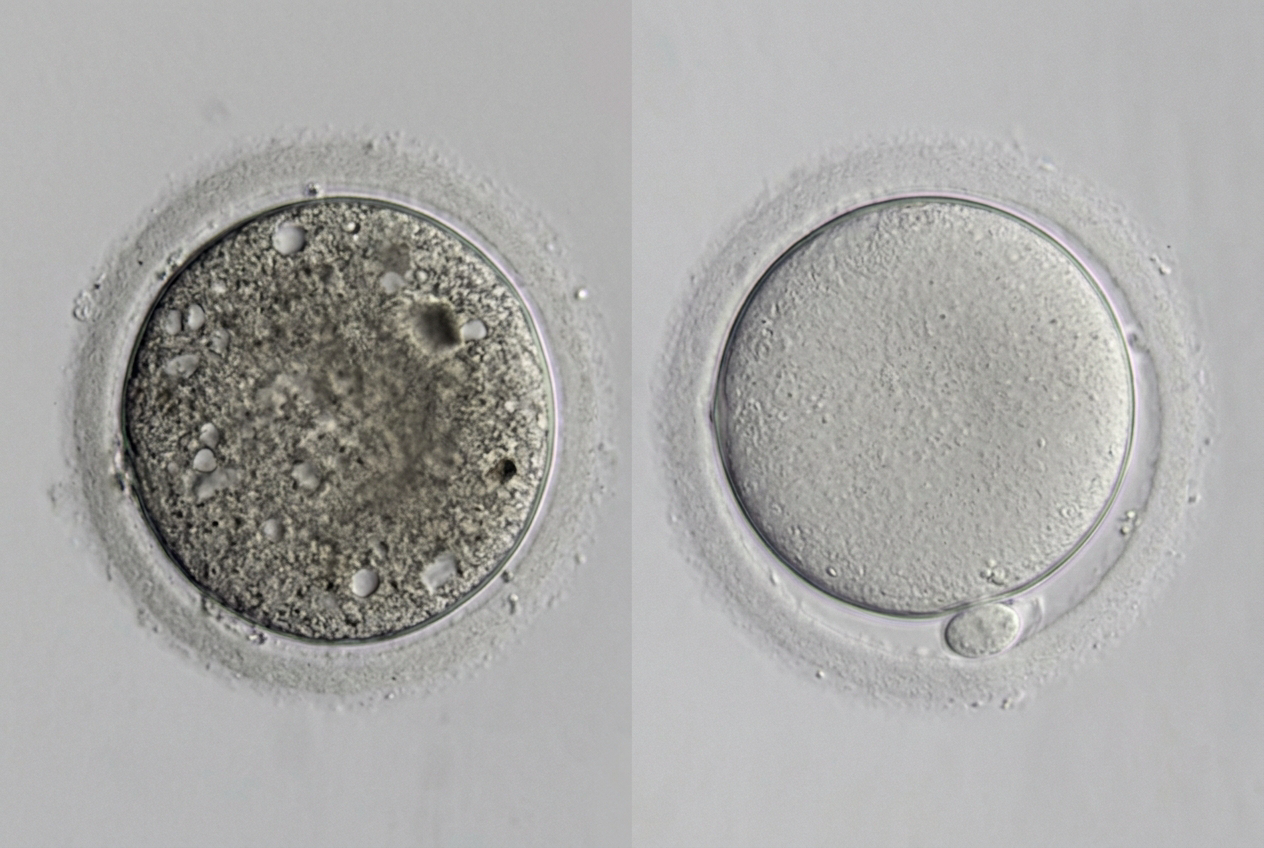
The doctor turned her monitor toward me and pointed at a cluster of grainy, uneven circles.
"These are your eggs from this cycle. See how dark and grainy they look?"
Then she pointed to a second image beside it — someone else's eggs. Round. Smooth. Bright.
"This is the quality we need for a viable embryo. Yours… aren't there."
A pause.
"With an AMH of 0.7 and this egg quality, I'd start thinking about donor eggs."
I was 38. Second IVF cycle. Zero embryos to transfer.
That sentence split me in two.
If you're trying to get pregnant right now…
If a doctor has talked about your "ovarian reserve" like it's a tank running dry…
If you've heard the words "poor egg quality" — and haven't been able to think about anything else since…
If you've watched your numbers fall apart one stage at a time — retrieved, then mature, then fertilized, then nothing to transfer…
If you're the one who reads the studies at 2 a.m., who knows her own numbers by heart, who walks into every appointment with questions the doctor doesn't expect…
Then what I found in the twelve weeks after that appointment might change everything.
My name is Danielle. I'm a project manager just outside Boston. And eleven months ago I was sitting in the clinic parking lot with my hands on the wheel — unable to drive, unable to call my husband, unable to do anything but stare at the report on the passenger seat.
I'm not telling you my story for sympathy.
I'm telling you because I finally found out WHY my eggs kept failing — and it was not the reason three different people in white coats had implied.

Everything was "in range" — except the result.
Let me back up.
My husband and I started trying in the summer of 2024. Regular cycles, 28–29 days. Positive ovulation tests every month. "Everything looks fine," the OB kept saying. "Give it time."
At 36, I thought: okay. We'll give it time.
Off the pill. Prenatal. Ovulation strips. A cycle app. "It just takes time at your age," everyone said. So we waited, and tracked, and waited.
Bloodwork and an ultrasound. AMH: 0.7. FSH: 11.4. "A little below average for your age," the doctor said, "but not dramatic. Keep trying." I went home and read about "diminished ovarian reserve" until 3 a.m. I couldn't stop looking at that number. It felt like a countdown clock bolted onto my whole life.
Month 14 — First IVF:
Two rounds of failed medicated cycles later, we moved to IVF. Weeks of injections. The bloating. The 6 a.m. monitoring appointments. And then the calls — the ones the women in my forums call "the hunger games" — that I'd rehearse in my head for days before they came.
Eggs retrieved: 8.
Mature: 5.
Fertilized: 3.
Made it to blast: 0.
They arrested by day three. Nothing to transfer. Nothing to freeze.
The doctor said the sentence that would follow me for a year: "Your response isn't the problem. It's the egg quality."
Month 19 — Second IVF:
New protocol. Higher doses. I did everything they told me — and I quietly added a shelf of supplements on top, because doing nothing felt worse.
Eggs retrieved: 6.
Mature: 4.
Fertilized: 2.
Made it to blast: 0.
Same story. Fewer eggs. The same collapse at every stage. The same nothing at the end.
That's the appointment where she turned the monitor toward me. Where she said "start thinking about donor eggs."
My ovaries, she told me, were "behaving like a 44-year-old's."
I asked her why. What was actually wrong with the eggs. Whether there was anything — anything — I could do.
"You have poor egg quality. That's really all we can tell you."
That night my husband slept. I didn't.
I lay there staring at the ceiling, running the same sentence on a loop:
My body gets there. It makes eggs. But the eggs themselves keep failing — and no one can tell me why.
I had done everything right. School. Career. Marriage. Savings. The one thing my body was supposed to just know how to do was the one thing breaking me.
I'd become someone who cried in the car after baby showers. Someone who muted her own pregnant friends on Instagram and then hated herself for it.
All I wanted was one good egg. One. That was the whole ask.
But I also knew this: if we were going to spend what was left of our savings on one more cycle, or make our peace with donor eggs, I would not arrive there wondering whether I'd skipped a step.
Then, before I said yes to donor eggs, I asked for one more opinion.
I couldn't sleep after that appointment. Every night the same thing: scrolling forums — r/IVF, r/DOR, the private groups. Story after story that sounded exactly like mine. No real answers.
Then one night a thread stopped me cold:
"Told to consider donor eggs at 38. Before I do — has anyone actually changed their egg quality for the next cycle?"
Halfway down the thread, one woman wrote something that made me sit straight up:
An embryologist. Not another prescriber. The person who actually looks at the eggs under the microscope — the one who makes those morning calls.
I found one who did second-opinion consults and booked it before I could talk myself out of it.
The 90 days that decide everything
Her name was Dr. Voss. She'd spent twenty years looking at eggs in a lab and making the calls I'd been on the other end of.
She read through my whole history — two retrievals, AMH falling, "poor egg quality" — and then she said the thing no one, in two years, had said to me:
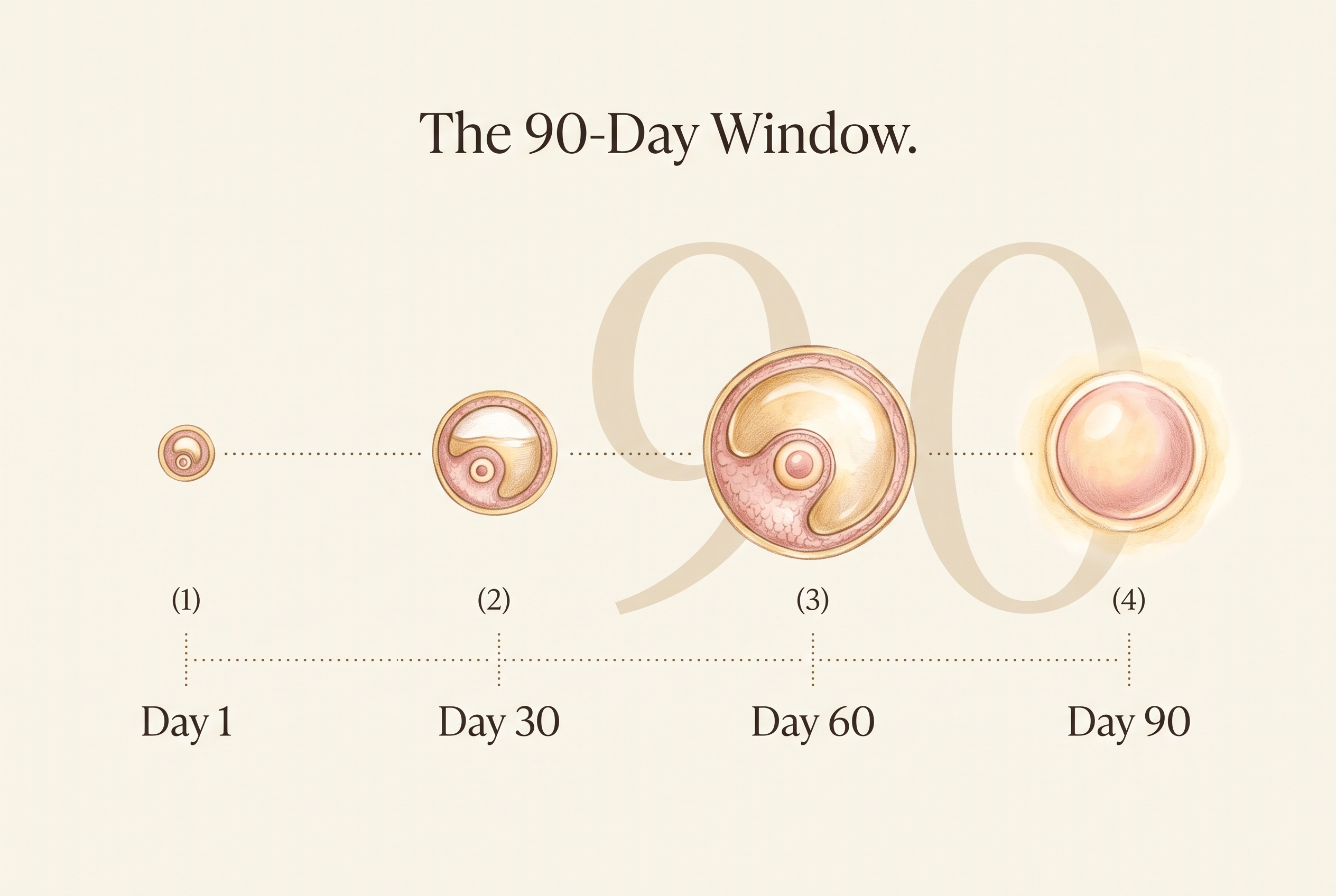
"The eggs we retrieved this cycle didn't start this cycle. They started their final maturation about ninety days ago."
She drew it out for me — the same picture I'd later find in dozens of studies.
When you ovulate, that egg wasn't "created" that month. For roughly the previous 90 days, it had been developing inside its follicle. Building its energy reserves. Assembling the machinery it would need to divide correctly after fertilization. Accumulating — or failing to accumulate — the antioxidant defenses that protect it from damage.
What happens — or doesn't happen — in those 90 days decides the quality of that egg. Not the day you ovulate. Not the week before. The three months before.
Then she used an image I'll never forget:
And then the sentence that hit me like a train:
"You've been trying to improve your eggs on the day they're retrieved. But that egg is already made. If you want to change the egg, you have to go back — to the 90 days before."
Why "poor quality" was never the whole story — the starved follicle
In that consult, and in the research she pointed me to, I finally understood what was actually happening inside my body.
1. The egg isn't new — it's been maturing for 90 days.
The egg retrieved on retrieval day spent roughly the previous three months developing inside a fluid-filled sac in your ovary called a follicle. Retrieval day isn't the start of the story. It's the final exam.
2. Inside that follicle, one thing feeds the egg.
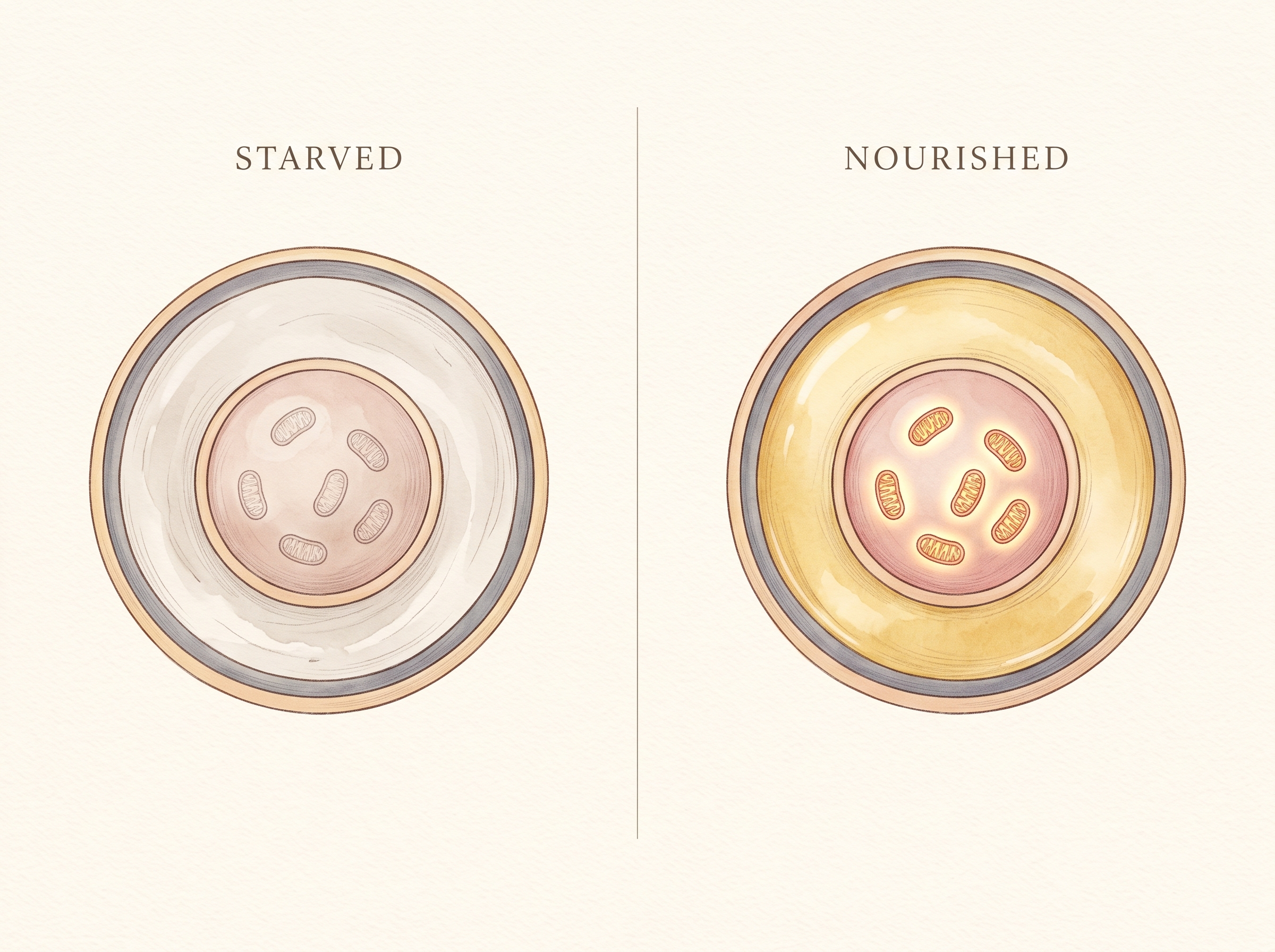
For the entire window, the egg is bathed in and nourished by follicular fluid. That fluid is its whole food supply — its water, its oxygen, its nutrients. Everything the egg needs to build itself has to come through that fluid.
3. Maturing takes more energy than almost anything a cell does.
To finish maturing — and to copy and separate its chromosomes correctly, the step that goes wrong in "poor quality" eggs — the egg needs an enormous amount of energy. That energy comes from its mitochondria: the tiny batteries inside the egg. And those batteries need two things from the fluid — fuel (CoQ10) and antioxidant protection from the cellular "rust" of oxidative stress.
4. With age, stress and back-to-back cycles, the fluid runs low.
As we get older — and under chronic stress, and after repeated stimulation cycles — that follicular fluid runs low on exactly what a maturing egg burns through most: energy and protection. So the egg finishes maturation under-fueled. It may look retrievable on the ultrasound. But it doesn't have the reserves to fertilize cleanly and keep dividing to a healthy blastocyst.
And suddenly every phone call made sense.
Retrieved — but not mature. Fertilized — but arrested by day three. It wasn't that my eggs were simply "too old." They'd finished maturing starved — over 90 days no one had ever fed.
My body wasn't broken. My ovulation worked. My eggs weren't the problem — the 90 days around them were.
And here's what landed hardest.
For two years, every doctor I'd seen had been staring at the seed. Was the egg good or bad. Normal or abnormal. Worth transferring or not. Months later I'd read a woman quote her own specialist, word for word — "there's nothing you can do; it's up to the embryo and luck." All seed. No soil.
Not one of them had asked the other question: what was the soil like in the 90 days that egg was growing?
I'd spent two years being judged on the seed. Nobody had ever fed the soil.
Why everything I'd been taking was working in the wrong place
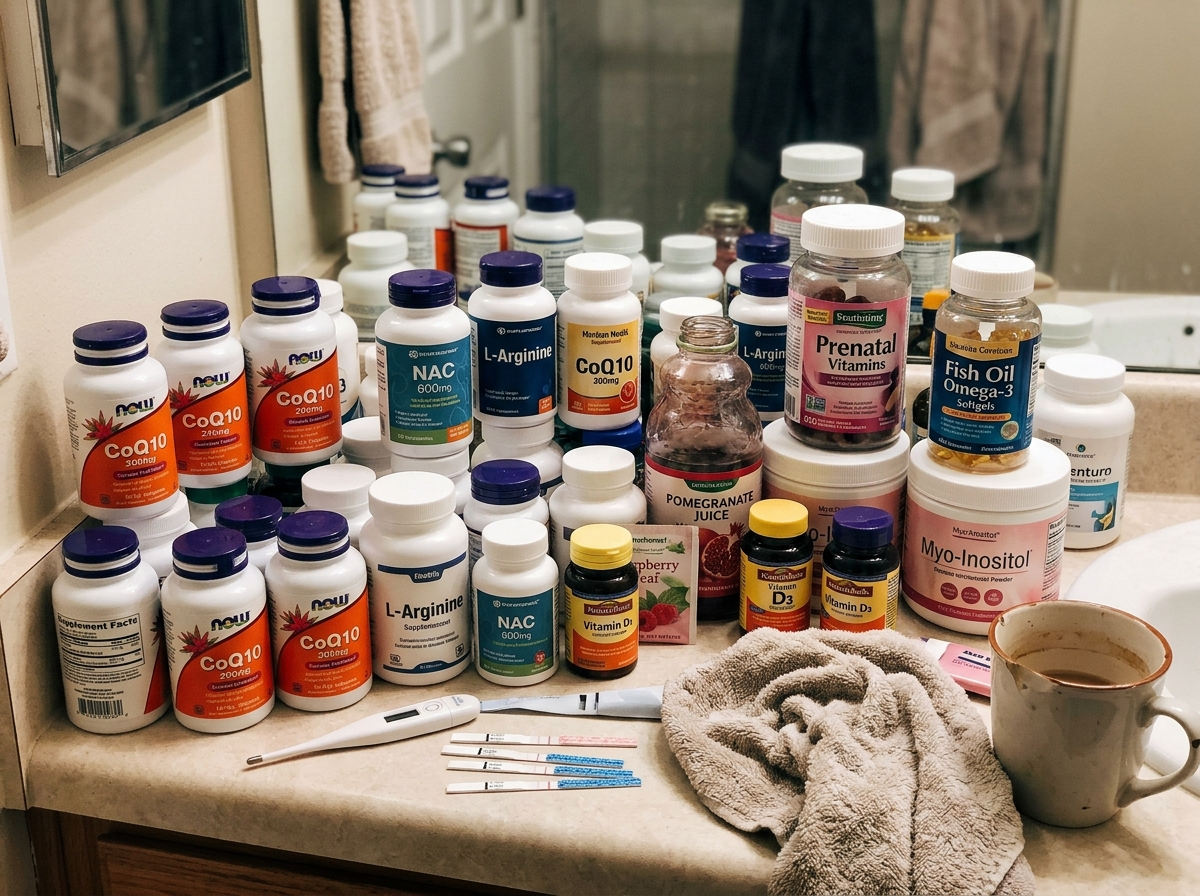
All at once I understood why nothing had worked — even though I'd done "all the right things."
My prenatal + folate (the one everyone takes):
Builds the baby. Protects against birth defects. Non-negotiable — I'm not arguing with it. But it does nothing for the energy an egg needs during its maturation window. Those are nutrients for later. I needed nutrients for now.
Generic CoQ10 capsules (from the pharmacy):
Here the idea was actually right — CoQ10 is the mitochondrial fuel. But two problems. First, standard CoQ10 in a hard capsule is fat-soluble and absorbs poorly — a fraction of what's on the label ever reaches your bloodstream, let alone the follicle. Second, I took it on and off, starting a few weeks before each cycle. Never across a full 90-day window. Right nutrient. Wrong form. Wrong timing.
Inositol:
Great for ovulation and insulin. But ovulation was never my problem — and inositol does nothing for mitochondrial energy inside the egg. Right supplement for a different door.
DHEA:
Aimed at my reserve — but the acne and the mood swings were brutal, and even then it was one lever pulling on one pathway. It couldn't touch the oxidative stress damaging the mitochondria.
And underneath all of it: I was choking down more than twenty pills a day. The CoQ10 softgels were the size of my thumb — I gagged on them every single morning, and I was supposed to take three. I forgot doses. By week three of every cycle I'd quietly stopped half of them.
So the window was never actually covered.
Every product touched ONE piece of the puzzle. Not one covered all three things a maturing egg needs — at the same time, for 90 straight days, in a form my body could actually absorb.
Dr. Voss called those three things the pillars of egg quality:
I didn't need another ovulation supplement.
I needed one thing that covered all three pillars — for 90 straight days — in a form I'd actually absorb and actually keep up.
And then she showed me what she'd built.
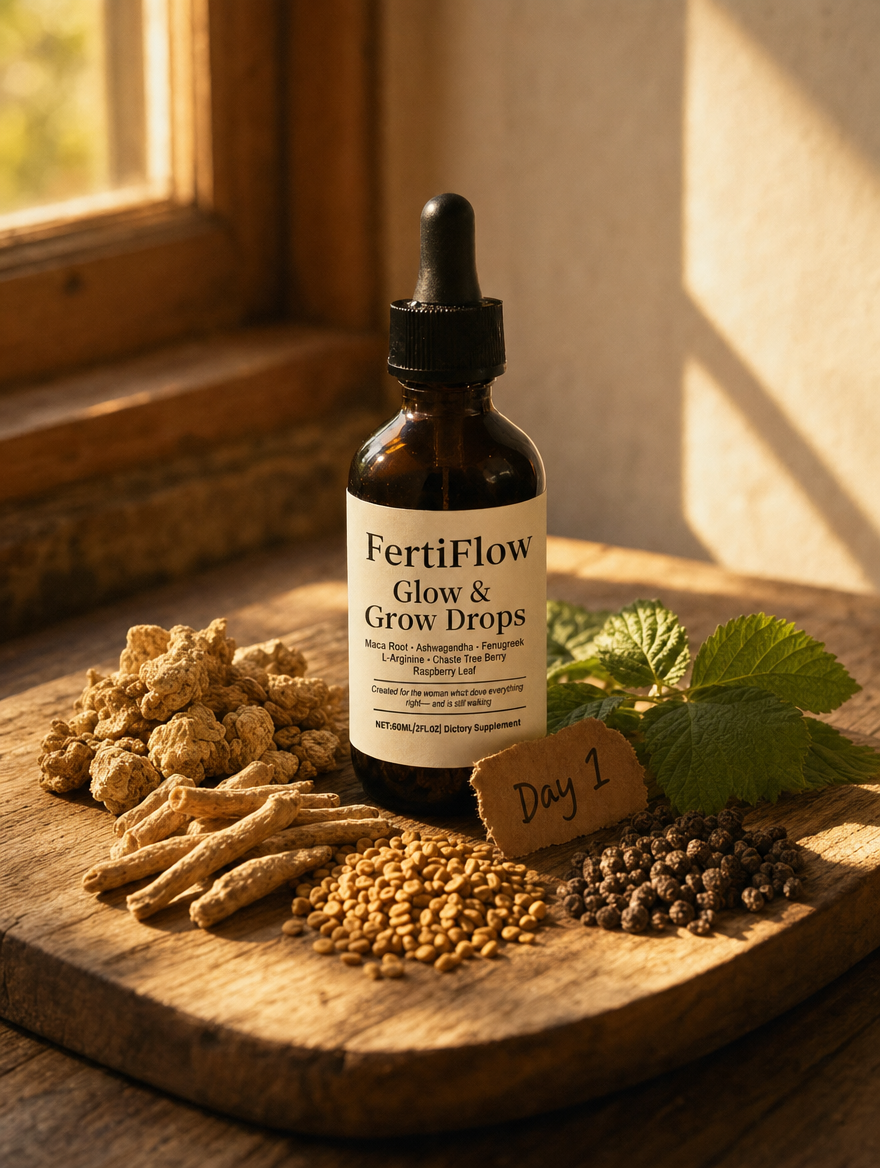
"I got tired of just explaining it — so I built something"
Dr. Voss told me she'd spent years watching this exact pattern and being able to say nothing about it. Two women, same age, same AMH — completely different eggs in the lab. The difference, she was convinced, lived in those unseen 90 days.
So she'd started putting patients on window-targeted regimens. The problem was the same one I'd hit: the twenty-pill stacks collapsed by week three. Nausea, life, forgetting. The window never got covered.
So she built a single daily liquid that covered all three pillars at once — so the window would actually get covered. She called it FertiFlow Glow & Grow Drops.
The ingredient list was the first one I'd seen that mapped exactly onto the three pillars she'd just drawn for me:
For mitochondrial energy:
Liposomal CoQ10 (ubiquinol) + a B-complex — the fuel the egg burns to mature and divide.
For antioxidant protection:
Resveratrol + Vitamin E + NAC — protecting the egg's DNA from oxidative damage across the whole maturation window.
For a stable environment:
Myo-inositol + Methylfolate + Vitamin D3 — the balanced backdrop an egg matures best in.
Three pillars. One formula. And this was the part that mattered most: it was liquid.
Not capsules. Not sachets. Drops.
The fat-soluble nutrients that actually have to reach your eggs — CoQ10 and resveratrol especially — are precisely the ones a hard capsule wastes. In a liposomal liquid, far more of what's in the bottle is in a form your body can actually take up and use. That's exactly why the generic CoQ10 capsules had done nothing for me: most of it left my body before it ever arrived.
I'll be honest about one thing, because I read labels obsessively and you probably do too: a dropper can't cram 600 mg of CoQ10 into a serving. That was never the point. The point is that what's in it is in a form you absorb — and that you can take it every single day for 90 days without gagging or quitting. A lower dose you fully absorb and never miss beats a mega-dose you half-absorb and abandon by week three.
I ordered the 3-month protocol. The recommendation was at least 2–3 months — because an egg takes about 90 days to mature. No "pregnant in 7 days" nonsense. Anyone who promises that doesn't understand the biology.
That honesty was the reason I finally trusted it.

The change — in numbers
The first change had nothing to do with fertility. It was my sleep. For the first time in months, I slept through the night — no 3 a.m. spirals counting days until ovulation. The cortisol fog started to lift.
My skin cleared a little. My energy came back. No measurable fertility data yet — but my body was clearly responding to something.
My cycle arrived on day 28. Exactly. For the first time in a year, I wasn't holding my breath counting. My cervical mucus changed — more of it, more days in a row instead of one.
At my baseline scan before the next cycle, the clinic counted a few more resting follicles than the time before. Small. But in the right direction. My new doctor said, "Something's working. Whatever you're doing — don't change it."
Month 3 (bottle three) — the retrieval:
This was the month that counted. Because the eggs that had been maturing since day one — the ones that got 90 continuous days of energy, protection, and a stable environment — were finally ready.
Third retrieval. Same clinic. Same protocol. Same me, one year later.
Eggs retrieved: 7.
Mature: 6.
Fertilized: 4.
Blastocysts: 3 — two of them top-grade.
The embryologist looked at me like I'd told her a lie. She pulled up my history. Compared the images from the two cycles before.
"I don't understand. This looks like a different patient."
Same ovaries. Same protocol. Same age — a year older, in fact.
The only thing that changed: 90 continuous days of the one thing my eggs had been missing.

But the real change wasn't the embryo report
The number of blasts mattered, of course. But it isn't the thing that changed me.
What changed me is that I stopped feeling defective.
For two years I believed my eggs were simply "too old." That my body had betrayed me. That my only option was another woman's eggs.
And I'd done the other thing the fertility internet tells you to do, too. I'd read the books that made me afraid of my own kitchen — afraid of receipts, of plastic containers, of the lining of a can and the shampoo in my shower. Underneath all the science, every one of them delivered the same quiet message: if this isn't working, look harder at what you did wrong. It wasn't a protocol. It was a verdict, dressed up as empowerment — and it was a lie.
Because nobody had ever told me that quality isn't fixed. That it can be influenced.
Not guaranteed. Influenced. With the right nutrients, in the right form, for the right length of time.
And it's that I can look at my husband now and not feel that wall of silence between us. We don't schedule sex "because it's the right day." We don't talk "protocols" at dinner.
We talk about names. About the color of a room.
We talk about a future — not about attempts.
Danielle's protocol was three bottles — one full 90-day window.
See the 90-day protocol »
"But isn't this just another expensive supplement?"
I get the skepticism. I was the first one to feel it. After two IVF cycles and bottles and bottles of supplements that changed nothing — hundreds of dollars of them — I didn't believe in anything anymore.
Here's what makes FertiFlow Glow & Grow Drops different from everything else on that bathroom shelf:
It isn't a generic prenatal.
It's built specifically around the 90-day egg-maturation window — not "general wellness," not "irregular cycles."
It isn't a capsule.
The liquid form is function, not aesthetics. The fat-soluble nutrients that have to reach your eggs are exactly the ones capsules waste. In drops, they arrive where they're needed.
It covers all three pillars at once.
Energy, protection, environment — together, for the full window, in a form you'll actually keep up. Not one lever pulled in isolation.
100% plant-based, no synthetic hormones
Third-party lab tested for purity and dose
30 seconds a day — a routine, not a 27-pill morning
Discreet shipping — no one needs to know what's in the box
And the part that finally let me hope safely: a 90-day, one-full-window money-back guarantee.
Ninety days — exactly the window an egg needs. If you go through the full protocol and you're not satisfied, you get your money back. No questions.
Let me also be clear about what it isn't. Age is real — and I won't insult you by pretending a bottle of drops erases it. FertiFlow Glow & Grow Drops is not a miracle. It won't guarantee a pregnancy. It can't open blocked tubes or fix a severe structural problem. It doesn't replace your clinic.
But it's the first thing I found that was built around the most important — and most ignored — fact in female fertility: your eggs need about 90 continuous days of real support to mature at their best.
This isn't a risk. The only real risk is arriving at your next cycle knowing there was a step you never took. Every woman I've talked to who's been through this wants the same thing on the other side of it, whatever the result: no what-ifs. To know she gave it everything. That's what these 90 days are.
And she wasn't the only one who found the window too late
Once I understood the 90-day window, I started seeing the same story everywhere — in the forums, in the groups, from women who'd been handed the same verdict and then quietly turned a cycle around:

The egg you'll retrieve in 90 days is maturing right now
Right now, as you read this, there is a follicle in your ovary with an egg that has already begun its final maturation.
In about 90 days, that egg will be ready. It will be the one you release. The one that could be fertilized. The one that could become your child.
Its quality is being decided now.
You can't go back and feed the egg you released last month.
But you can start today feeding the one you'll release in 90 days.
Every month you wait is another cohort of eggs maturing unprepared — while you work on everything except the window.
The clock doesn't slow down while you decide.
You've never been the woman who skips a step. This is just the step no one ever handed you.
The window is open. But it's open now.

The 3-Month Protocol: one full egg-maturation window
Check availability »Why three months? Because an egg takes about 90 days to mature. This protocol covers the entire window — from the start of maturation to ovulation. No gaps, no missed weeks. One bottle for each month of the window.